Board Logic For Steady Reel Control
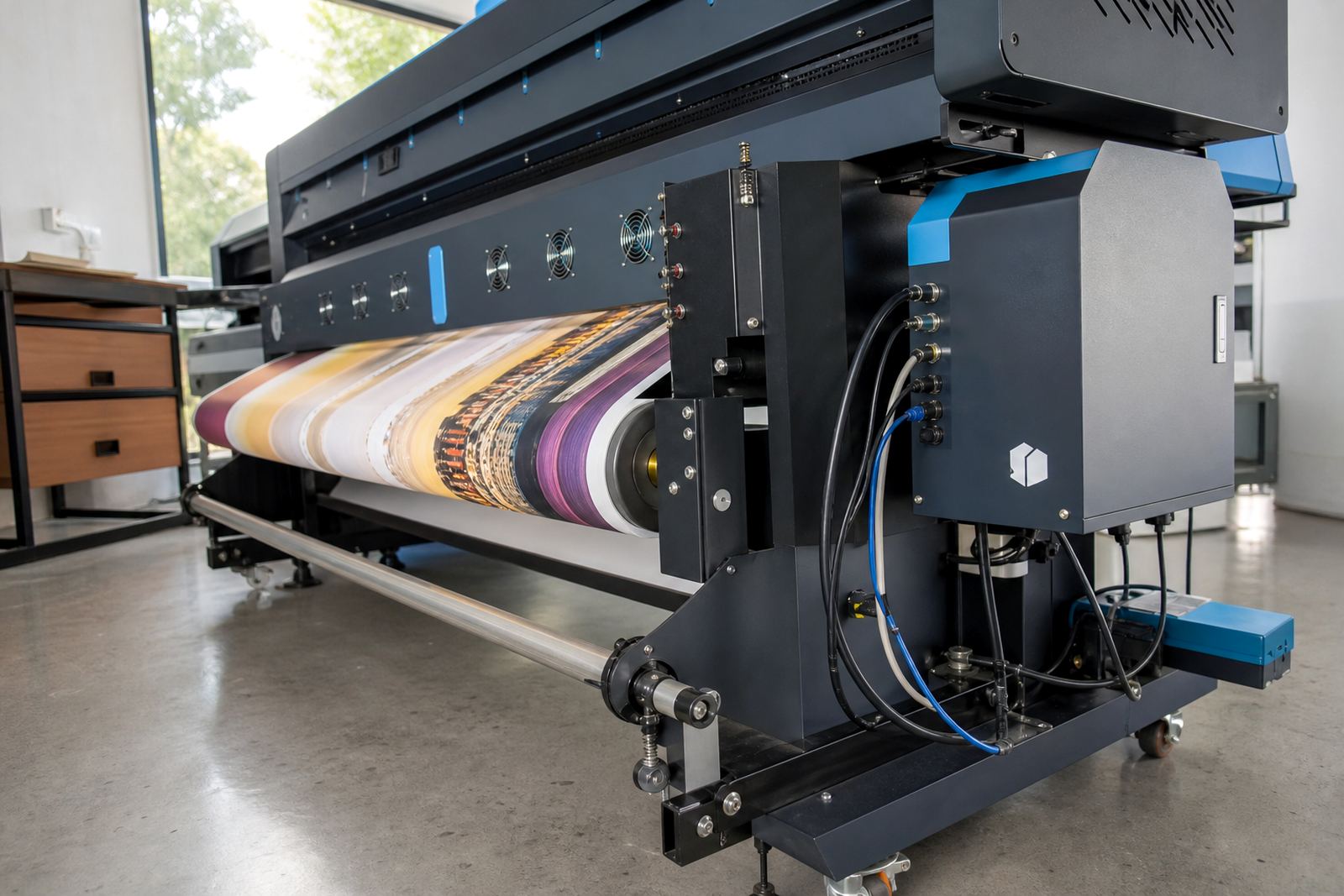
This board manages the take-up motor signal and keeps winding matched to printer speed, so the media does not slacken or pull too hard during production. In practical terms, it helps the roll wind straight, which matters when you are running long panels, repeated jobs, or heavier media that can drift on the core. The control board is used inside the take-up system assembly and works with the printer’s own feed timing, so the collection side keeps pace with the print carriage and media path.
On wide-format machines, even a small timing mismatch can show up as telescoping, creased edges, or uneven roll build-up. A good board helps the operator hold a cleaner roll shape and reduces the need to stop and hand-adjust media during a job.
Setups That Benefit Most In Daily Production
Take-up boards suit print environments that run extended jobs and need tidy collection at the end of each pass. They are commonly used on machines handling exhibition graphics, site boards, vinyl graphics, wallpaper panels, fabric prints and other roll-fed work. In humid coastal areas such as Durban and Cape Town, stable winding is helpful because media can react to moisture and shift slightly during a long print. Midrand and the inland corridors around Johannesburg and Pretoria often see heavier daily output, where consistent take-up control keeps the operator from fighting the roll every few metres.
- Long banner runs where roll tension must stay even
- Repeated production jobs with identical media widths
- Print rooms that collect finished output onto a core
- Machines that need cleaner winding on thinner films
- Jobs where edge curl or slack can disturb registration
Sizes, Signals And Board Options To Match The Machine
Boards are selected to suit the printer control system, the motor type and the way the take-up unit is triggered. Some machines use a simple start and stop signal, while others need finer control over speed, direction, or sensor input. We work with control boards used in wide-format inkjet systems and can match the board to the existing wiring, motor load and interface style used by the printer.
Typical options include compact boards for single take-up units, and more advanced boards that support sensor feedback or multiple operating modes. Cable length, connector type and mounting pattern matter just as much as the electronics, because an incorrect fit can create false signals or unstable winding. When the board is matched properly, the take-up unit runs with less noise and less manual correction from the operator.
- Single take-up control boards for standard roll collection
- Boards with sensor input for media movement feedback
- Controller matched to the printer’s existing motor setup
- Mounting and connector match for the cabinet layout
- Options suited to wide-format inkjet production environments
Fitting Notes For A Cleaner Installation
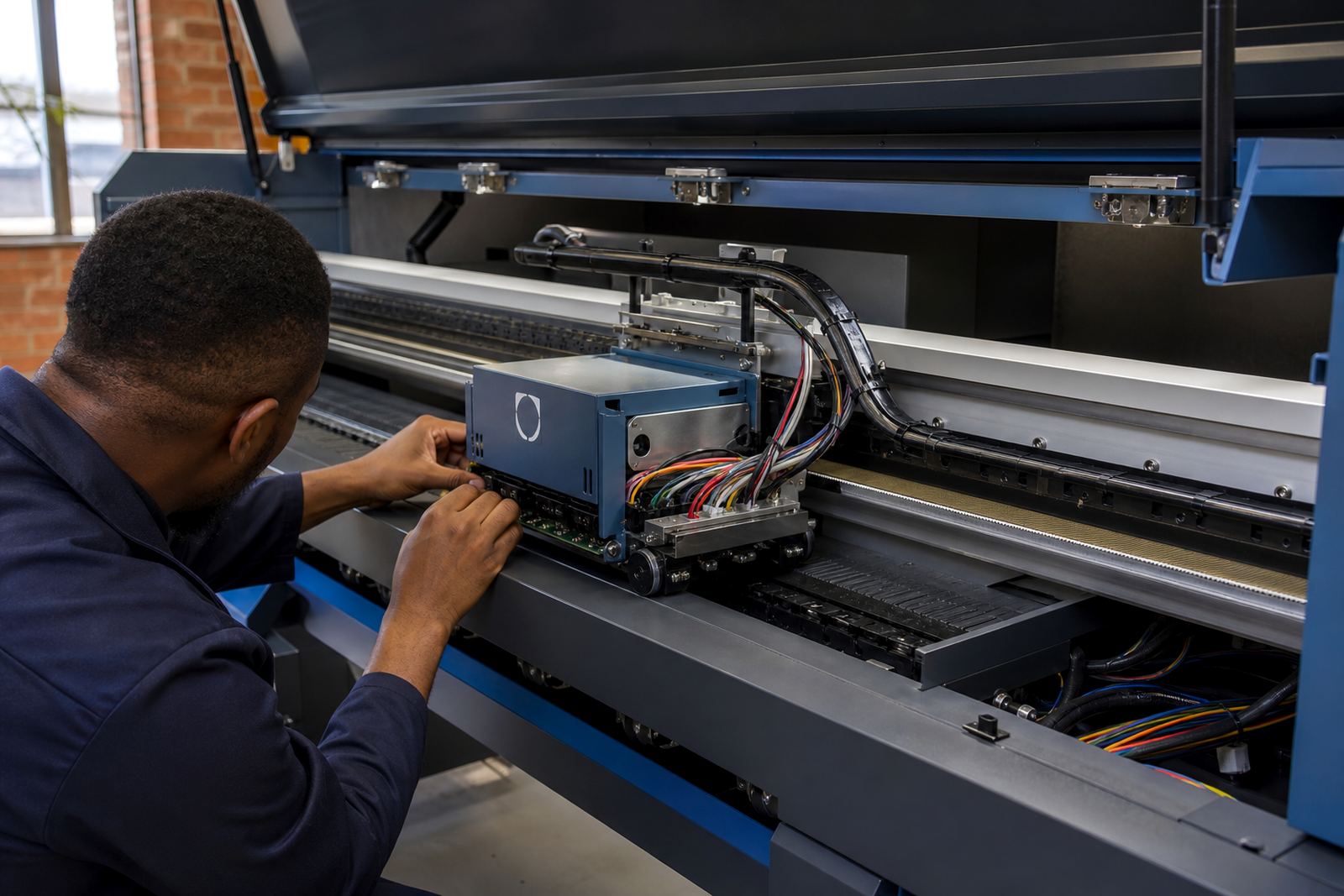
Installation is usually handled as part of a wider printer board or workflow job, because the board must be wired correctly and aligned with the printer’s control logic. A technician checks signal polarity, motor direction, sensor position and the take-up start condition before the unit is put into production. On some machines the board is tied into the printer’s main control path, so correct setup is important to avoid erratic winding or a unit that starts too early.
Remote setup can be arranged for shops across South Africa when the printer model and existing wiring support it, although physical board fitting still depends on the machine layout and access inside the cabinet. In production rooms that run several shifts, we also check how the take-up behaves with the fastest working speed, because a board that behaves well at slow output can struggle when the printer is pushed harder.
Care That Keeps The Board And Take-Up Clean
Like most control electronics in a print room, the board lasts longer when dust, ink mist and loose fibre are kept away from the cabinet. Connections should be checked for looseness, especially after transport or after a period of heavy vibration. If the unit begins to wind unevenly, the fault may sit in the board, the motor wiring, the sensor, or even the take-up core itself, so the whole path needs a proper look.
- Keep the cabinet dry and free of ink overspray
- Inspect connectors after moving the printer or take-up unit
- Watch for uneven roll build-up on long jobs
- Clean sensors and nearby rollers with care
- Check cable strain where the harness bends repeatedly
Preventive maintenance is useful for shops that print daily, especially where operators swap media often and the take-up sees repeated loading and unloading.
Ordering Details To Confirm Before Supply
When you enquire through the contact page form, it helps to have the printer model, the current take-up arrangement and a clear note on whether the board is for a new fit or a replacement. Motor type, connector style and the number of control points all matter. If the printer already uses a specific sensor arrangement, that should be included as well, because a mismatch can leave the take-up running out of sync.
It is also useful to note the media widths you normally run, the longest roll length in production, and whether the machine is used for light day work or heavier shift output. For shops in Johannesburg, Pretoria, Durban, Cape Town, Bloemfontein and the East Rand or West Rand, that detail helps match the board to the real working pattern rather than a loose general guess.
- Printer make and exact model reference
- Take-up motor type and voltage details
- Connector style and cable length required
- Sensor arrangement already fitted to the machine
- Media width and typical roll length
- Whether it is a replacement or a new installation
Local Support For Print Rooms Across The Country
InkFlow RIP supplies printer control boards and RIP software from Midrand, with remote setup and support for wide-format print rooms across South Africa. The work often links with RIP installation, board installation, printhead driver setup, colour profile setup, queue workflow design, fault finding, preventive maintenance, operator training, production tuning, backup and recovery, and ongoing support. For take-up systems, that broader view matters because a clean roll is part of the same production chain as the RIP, the driver settings and the operator’s daily routine.
Thabo Zungu leads the business, with Lerato Khoza, Johan Letsoalo, Zanele Moagi, Aiden Phiri, Kagiso Pienaar and Bianca Rademeyer supporting day-to-day work across Midrand and surrounding service areas. That team structure helps when a print shop needs more than a single part, because the board, the print path and the output workflow often need to line up as one working system.
Key facts
| Product type | Take-up system control board for wide-format inkjet printers |
|---|---|
| Main function | Synchronises take-up winding with printer output during long runs |
| Compatibility | Matched to printer model, motor type, wiring and sensor layout |
| Installation | Board fitting, wiring check, signal setup and take-up test run |
| Use cases | Banner, vinyl, paper, wallpaper, fabric and other roll-fed work |
| Support | Remote setup, fault finding and workflow support across South Africa |