

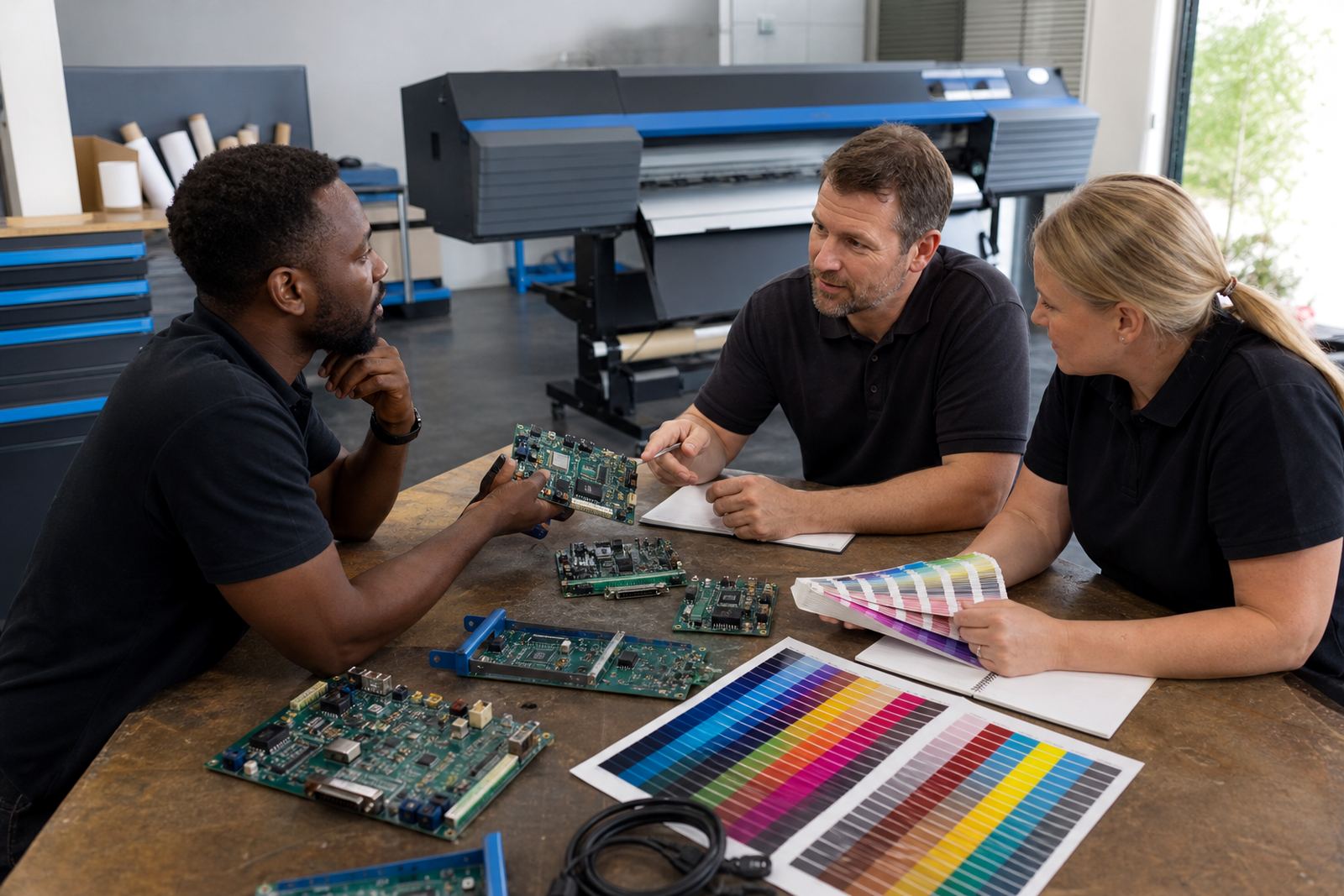
Built Around Wide-Format Production, Not General IT
InkFlow RIP focuses on the parts of wide-format printing that affect output every day: control boards, printhead driver setup, RIP software, colour profiles, queue handling and maintenance planning. That means the work is grounded in printer behaviour on real jobs, not in broad advice that ignores the way a machine handles ink laydown, pass counts and substrate changes.
Our base in Midrand gives us a practical point for support across Johannesburg, Pretoria, Durban, Cape Town, Bloemfontein and surrounding production areas. Some clients need a fresh installation on one machine, while others need help standardising several printers across a workshop, with operator steps that make sense on a busy floor.
We deal with the small details that shape output quality too. Head alignment, media feed control, queue order, ink limits and maintenance cycles can all affect the final print, and poor settings can waste material fast. Coastal humidity in places like Durban and Cape Town can change how media behaves and how printers are kept in working order, so the settings and maintenance schedule need local judgement rather than guesswork.
The Work We Handle On Real Print Floors
Our services cover the full run of control and workflow tasks around wide-format inkjet printing. Some jobs are remote, some are on site, and some are split between setup and follow-up support once the operators have started using the system. Where a board fault is involved, the aim is to get the printer back into a controlled state with less disruption to the queue.
- RIP installation and setup for production use
- Printer control board installation and board fault checking
- Remote setup for print shops across South Africa
- Printhead driver configuration and signal handling
- Colour profile setup for repeatable output
- Queue workflow design for mixed jobs and rush work
- Fault finding, preventive maintenance and backup recovery
- Operator training and production tuning for daily use
We keep the conversation practical. A designer may care about accurate colour across a short run, while a production manager may care more about queue order, media handling and reducing stoppages across a long shift. Both matter, and both are part of the same printing system.
Colour That Holds Together From Screen to Substrate
Colour work is not just about making a print look bright. It is about controlling how the printer interprets files, how the RIP handles ink channels, and how the final output behaves on the chosen media. That can change across coated vinyl, banner stock, backlit media, canvas and other wide-format materials.
Our colour workflow specialist and RIP technician work with profiles, ink limits and test charts to bring output into line with the job requirement. When a printer is drifting, the result can show up as a colour cast, banding or a mismatch between repeats on the same run. That creates waste and slows the floor down.
Good colour control also helps when multiple operators are sharing a production line. If one person prints in the morning and another takes over later, the workflow needs to stay predictable, otherwise the machine starts behaving like two different systems instead of one. We set up the process so it is easier to repeat the same result without extra fiddling.
How We Work With Teams, Operators and Production Managers
We spend a lot of time in the middle of the production process, where settings, habits and machine condition all meet. That usually means speaking to more than one person at a site. The MD, production lead, operator and maintenance person may each see a different part of the issue, so the job is to connect those pieces into one working setup.
Training is part of that process. A board or RIP package can be technically correct and still cause trouble if the operators are unclear on queue flow, file handling or maintenance steps. We keep the instruction direct and grounded in what the machine actually does on the floor, not in abstract theory that does not help at 6 am when orders are waiting.
- We look at how jobs enter the queue and move through output
- We check whether colour settings match the media in use
- We test whether the board and driver path are stable
- We show operators the steps that affect print consistency
- We leave maintenance tasks in a format people can actually follow
That mix of support and training matters in larger shops too, where more than one printer may be running at once. A good setup should not need constant rescue, and the people using it should know where the pressure points are.
Remote Support That Still Stays Close To The Machine
Remote support works well for software, queue design, profile work and many fault checks, especially when the printer is already connected and the issue can be traced through settings and logs. For sites in Johannesburg, Pretoria, Durban, Cape Town, Bloemfontein and the East and West Rand, this saves a lot of downtime when the issue sits in configuration rather than hardware.
When the matter points to a control board, printhead driver or physical machine fault, the approach changes. The aim then is to isolate the problem properly, protect the job queue and avoid unnecessary changes that make later diagnosis harder. That is often where bad habits creep in, especially when a shop is under pressure and someone keeps altering settings in search of a quick fix.
We also pay attention to backup and recovery. RIP presets, colour data and workflow settings are easy to overlook until a machine is reset or a drive fails. Keeping those records in order helps a shop recover with less confusion, and it can save hours of rework after a service event.
A Midrand Base With Work Spanning The Country
Being based in Midrand puts us close to many of Gauteng’s print operations, logistics routes and industrial areas, which helps when a setup has to fit into a live production schedule. It also gives us a good working view of what local shops need, from smaller specialist studios to larger facilities handling volume work.
Across South Africa, printing conditions differ in ways that matter. A shop in Durban may need extra attention to humidity and media storage, while a Cape Town operation may deal with different environmental conditions and delivery timing. Inland sites may face their own issues with dust, heat and equipment handling. We take those factors into account because they affect the print path just as much as the software settings do.
Our work is steady, technical and practical. That is how we prefer to handle printer control boards and RIP systems, because the job is only useful when the machine can carry on producing accurate output the next day, not just on the day of installation.